


The Beautiful Essence of the Labradorite
Hold a piece of labradorite flat in your palm and it can look like plain grey stone. Turn it a few degrees and a seam of electric blue opens across the surface, then green, then a flicker of gold that disappears as quickly as it arrived. That sliding flash is why this feldspar picked up the name "stone of magic," and it is why people who buy one piece tend to come back for another.
It is also a forgiving stone to own. Labradorite is not rare, not especially fragile, and not expensive to replace, which is more than can be said for most of the minerals sold beside it. What follows covers what labradorite actually is, what it has meant to the people who carved and wore it, how it is used now, and how to keep the flash bright.
Table of Contents
- What Is Labradorite?
- The Meaning of Labradorite
- The Benefits of Labradorite
- Labradorite Crystals for Courage
- How to Use Labradorite
- Labradorite With Feng Shui
- Meditation With Labradorite
- Labradorite and the Zodiac
- Crystal Combinations With Labradorite
- Labradorite vs. Moonstone
- How to Cleanse and Charge Labradorite
- Conclusion
- FAQs

What Is Labradorite?
Labradorite is a calcium-rich feldspar that forms in igneous rock — gabbro, basalt, norite — where molten material cooled slowly enough for large crystals to grow. Chemically it is unremarkable. Optically it is not: thin layers inside the crystal split incoming light and send back only certain wavelengths, an effect mineralogists call labradorescence and everyone else calls the flash. Blue is the most common colour, but green, gold, and orange turn up in the same stone as your hand moves, and a rare few pieces throw something close to the whole spectrum.
On the Mohs scale labradorite sits at about 6 to 6.5, roughly between opal and quartz. That is hard enough for a bracelet or a pendant worn every day, though a ring takes more knocks than the stone really wants.
The Meaning of Labradorite
The stone's reputation is older than the gem trade. Along the Labrador coast, one story holds that the northern lights were once trapped inside the coastal rocks, and that a warrior freed them with a strike of his spear — leaving the colours behind in the stone. Whether the story is literally true matters less than what it explains: labradorite has been carried as a talisman for a long time, not simply worn as decoration.
In the crystal-healing tradition the stone is read as a companion for change. It is said to steady the mind when too many things are happening at once, and to make it easier to say the thing you have been circling for weeks. Those are beliefs rather than clinical claims, but they are the reason labradorite is so often described as a stone for people in the middle of something — a move, a new job, a decision that has been put off too long.
In practice, the meaning people attach to labradorite tends to follow the flash itself: something only visible from the right angle, easy to miss if you are not paying attention.
The Benefits of Labradorite
Ask anyone who wears labradorite daily and you will hear roughly the same short list: steadier mood, a clearer head, fewer of the circular thoughts that keep people awake at two in the morning. Wearers describe it as grounding without being heavy — unlike hematite or obsidian, it does not seem to slow anything down.

The second half of the list is about confidence: putting a stop to the running argument with yourself about whether you are ready, whether the work is good enough, whether it is too late to start. Labradorite is a popular stone with anyone rebuilding after a setback, largely because it is associated with the moment a decision stops being reversible — the point where you stop asking and start doing.
Labradorite Crystals for Courage
Courage is the property labradorite is best known for, and it is usually described in an unglamorous way: not the courage to charge at something, but the willingness to be seen trying. Working with the stone is often framed as a way of lowering the stakes enough that you can begin — talking to the person you have been avoiding, sending the application, saying the number you actually want out loud.
It is also worn by people who have to make decisions quickly and then defend them: shop owners, teachers, anyone whose day is a queue of small judgements. Whether the stone does anything or simply reminds you to do it, the effect people report is the same — less second-guessing, faster decisions.
How to Use Labradorite
There is no wrong way, but some ways put the stone closer to you than others. A bracelet or a pendant sits against the skin for hours; a tumbled stone in a pocket does the same and is easier to keep. Pieces kept in a room — on a desk, on a windowsill where light can reach them — are usually chosen for the flash rather than the meaning, and there is nothing wrong with that either.
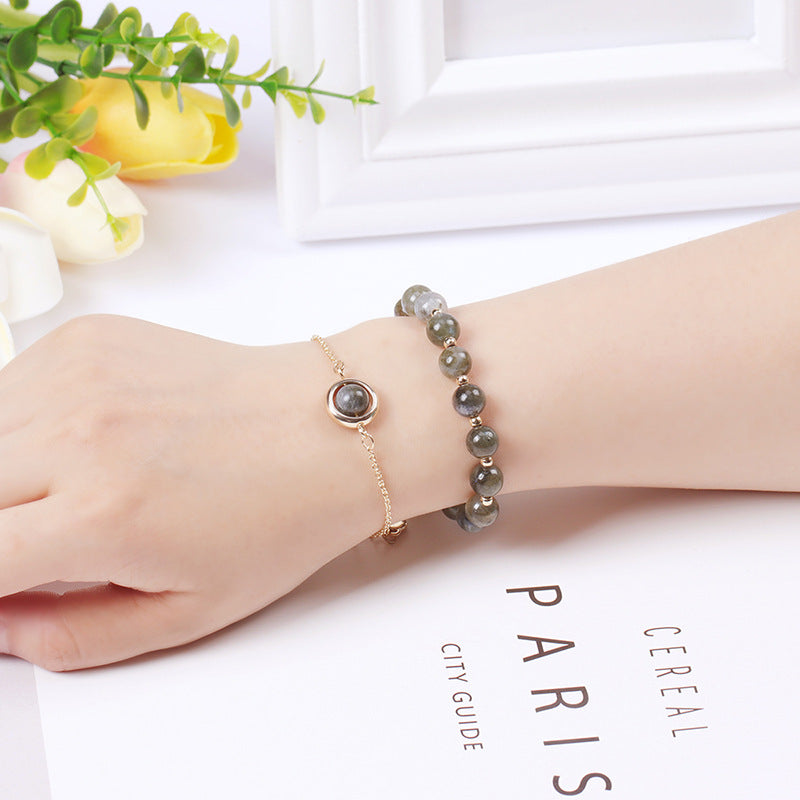
If you would rather wear the stone than carry it, our natural labradorite bead bracelet is a plain strand of labradorite beads on a rope cord — the kind of piece you can leave on for weeks without thinking about it.
Whichever form you choose, wear it where you can see it. Labradorite is a stone you have to look at to get anything out of, and the flash is the part of it that is genuinely worth watching.
Labradorite With Feng Shui
In feng shui, labradorite is placed for the same reason it is worn: to settle a room that feels scattered. The usual spot is the southwest corner, which the tradition links to relationships and to the calm that makes them work. A smaller piece on a desk, or beside a doorway, is a common alternative.
The practical advice is about light. Labradorite needs a direct source to do anything visually, so a windowsill, a shelf lamp, or anywhere the sun crosses during the day will show the stone at its best. A piece kept in a drawer is just a rock, however beautiful the rock.
Meditation With Labradorite
Meditating with labradorite is simple enough to do without instruction. Hold the stone, or set it at eye level, and give the flash a minute of your attention before you close your eyes. The colour shifts as your hand moves, and following it is a decent way to arrive at stillness without forcing it.
People who use the stone this way tend to keep sessions short — ten or fifteen minutes — and to bring a question rather than a wish. It is a working stone, not a ceremonial one; the point is to leave the cushion with a clearer next step.
Labradorite and the Zodiac
Labradorite is not one of the twelve traditional birthstones; it joined modern birthstone lists only recently. It is most often paired with Pisces, whose season runs through late February and March, on the grounds that a sign known for absorbing other people's moods benefits from a stone associated with boundaries and clear sight.
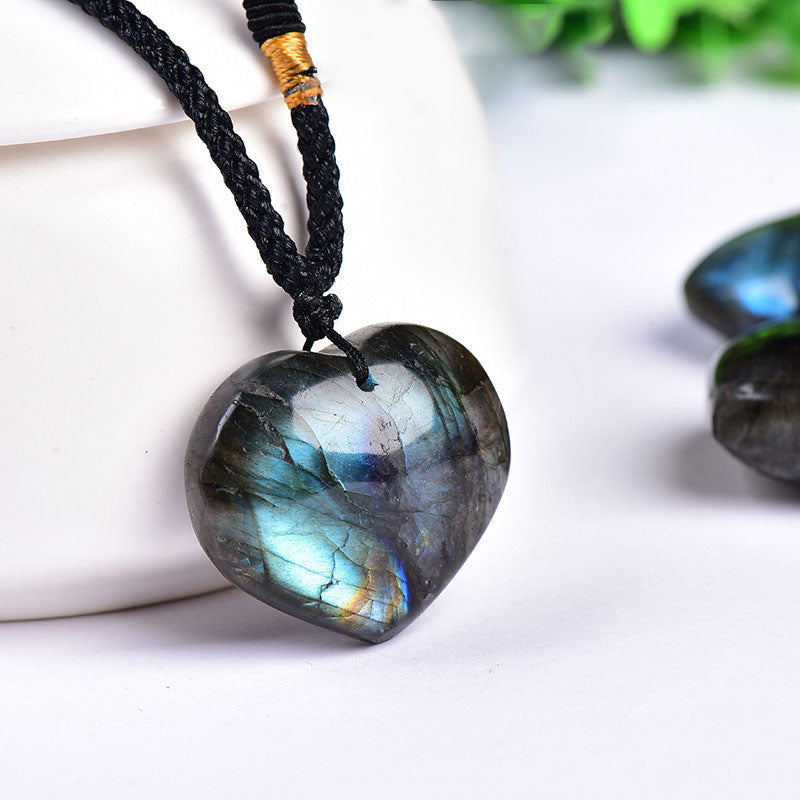
Leo and Libra are the other two signs commonly given labradorite, though the reasoning is looser. As with most stone-and-sign pairings, the useful test is personal: wear it for a fortnight and see whether you reach for it or forget it.
Crystal Combinations With Labradorite
Labradorite works well with other stones because it is not a single-note crystal; it tends to amplify whatever it is paired with. Six combinations people come back to:
- Labradorite and moonstone — for anyone who feels stuck. Moonstone is the softer of the two, and the pairing is usually described as courage plus direction: one stone to quiet the fear, another to decide what to do next.
- Labradorite and amethyst — both are quiet stones, and together they are used for the evenings, when the mind will not slow down. Amethyst brings the calm; labradorite keeps the calm from turning into avoidance.
- Labradorite and lapis lazuli — a pair for people who need to speak up. Lapis is associated with expression and self-respect, labradorite with the nerve to use it.
- Labradorite and hematite — for overload. Hematite is the grounding half, labradorite the part that sorts the useful information from the noise.
- Labradorite and fluorite — a study pairing. Fluorite is linked to concentration and clear decisions; labradorite adds the willingness to act on them.
- Labradorite and rose quartz — for relationships, especially the ones that need a difficult conversation. Rose quartz softens, labradorite steadies.

Labradorite vs. Moonstone
These two are easy to confuse, and a good deal of the confusion comes from the trade. Both are feldspars, both are sold as pale stones with a floating light inside, and "rainbow moonstone" — the milky white stone with the blue sheen — is in fact a variety of labradorite, not moonstone at all.
Genuine moonstone is orthoclase, and the effect it shows is adularescence: a soft, billowing glow that drifts across the whole surface. Labradorite's flash is sharper and more directional. It appears in blocks or seams, it usually sits on a darker grey or black background, and it vanishes completely when you turn the stone away from the light. If the light moves as one piece across the stone, it is moonstone; if it arrives in flashes at one angle and disappears at another, it is labradorite.
How to Cleanse and Charge Labradorite
Cleaning is a cloth-and-lukewarm-water job. Wipe the stone with a soft damp cloth, dry it, then buff it with a dry one; a drop of mild soap is fine if it has been worn against sunscreen or lotion. Keep it away from household chemicals, bleach, and ultrasonic cleaners — the flash is structural, but the surface carrying it is not indestructible.

To recharge a piece, leave it in moonlight overnight and let it air-dry on a windowsill. Bright sunlight is not necessary, and long exposure is not recommended — the colours will not fade on their own, but heat and sudden temperature changes are unkind to feldspar. If a stone sits on a shelf for months, pick it up now and then and give it a wipe. Dust dulls the flash faster than most people expect.
Conclusion
Labradorite is one of the few stones whose appeal survives close inspection. It is not rare, it is not hard to care for, and the thing that makes it worth owning — a colour that only appears when you move — is very difficult to fake convincingly in glass or resin. Read as a talisman or kept simply as a good-looking piece of stone, it asks for the same thing either way: that you look at it now and then. That is the whole trick.
FAQs
Is labradorite natural, or is it treated?
The flash is natural; the treatment, when there is one, sits on top of it. Weak material is sometimes given a coating or a coloured backing to make the colour look stronger and more even. A treated stone tends to show its colour from every angle and looks flat while doing it. A natural one loses the flash entirely when you rotate it away from the light.
How can I tell a real labradorite from an imitation?
Glass and resin copies sparkle evenly, like glitter suspended in the stone, and their body colour is usually too clean — real labradorite has a grey or dark base with visible internal fractures and a flash that appears in seams. Look at the stone from three or four angles before you buy. If the colour is identical on all of them, it is not labradorescence.
Can labradorite go in water?
Briefly, yes. A quick rinse in lukewarm water will not damage the stone, and a bracelet that has been worn all summer can be rinsed and dried without worry. Prolonged soaking, salt water, and hot water are the ones to avoid — none of them will dissolve labradorite, but they can dull the surface and loosen the cord on a beaded piece.
Is labradorite hard enough for an everyday ring?
At 6 to 6.5 on the Mohs scale it is fine for a bracelet, a pendant, or a pair of earrings, and marginal for a ring. Anything worn on a hand meets doorframes and tabletops all day, so a labradorite ring will pick up small scratches and, eventually, a knock it does not survive. If you want a stone for daily rings, look above 7; if you love the flash, wear it as a pendant and save the ring for occasional days. Store labradorite apart from harder stones so nothing grinds against it in a drawer.
Is labradorite good to sleep with?
Many people keep a piece on the bedside table rather than under the pillow. Labradorite is a waking stone in most descriptions — associated with clear thinking and decisions — and some wearers find it too stimulating to fall asleep against. A bracelet left on the nightstand gives you the last look at the flash without the restlessness, and if you do sleep in it, give it a few nights before deciding whether it helps.
Where is labradorite found?
It is named for Labrador in Canada, where it was first identified on the coast in the 1770s, and Canada still produces some of the finest material. Today the stone is also mined in Madagascar, Finland, Russia, Greenland, and India. Most of the beads and cabochons sold in jewellery come from Madagascar, which is why labradorite is affordable in a way that many gemstones with a comparable optical effect are not.


