


How to Use a Singing Bowl? The Beginner's Guide
The Tibetan Singing bowl sounds strange the first time you hear one, and the sound is the reason people come back to it. The note hangs in the air far longer than a bell's, and that long decay is what makes the bowl useful for meditation, yoga, and sound massage. Bowls are graded by octave, frequency, and note.
Crystal bowls, unique singing bowls, and metal bowls all answer differently because of their weight and size. This guide covers the basics, then the mallets, the overtones, and how to play one yourself.
- What Is a Tibetan Singing Bowl?
- How Do Singing Bowls Create Sound?
- Where are Singing Bowls Made?
- How to Use a Singing Bowl?
- Where the Benefits Actually Show Up
- Will Singing Bowls of Different Sizes Produce Tones Differently?
- How to Use a Singing Bowl for Healing or Cleansing?
- Can You Put Water in a Singing Bowl?
- What Do You Know About Singing Bowl Meditation?
- Singing Bowl Mallet Types
- Final Thoughts
- FAQs

What Is a Tibetan Singing Bowl?
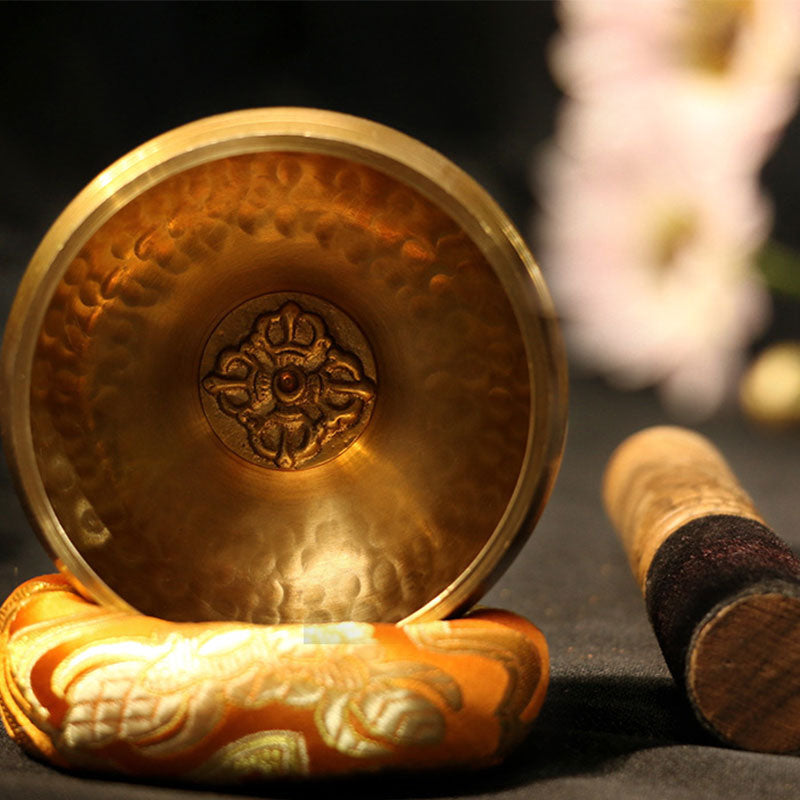
Tibetan singing bowls are also known as Himalayan singing bowls: bells that are struck rather than rung, with a sound that settles the mind.
Yoga and massage therapists use them during treatment, and Buddhist monks have used them for meditation.
How Do Singing Bowls Create Sound?
A Tibetan singing bowl depends on vibration and friction to make its sound, the same as most musical instruments.
Singing bowls are known as idiophones, which are instruments that emit sound only by vibration produced by physical touch. Once you rub the rim with the help of a mallet, it produces friction, which results in vibrations. The sounds created by singing bowls consist of different tones.
Where are Singing Bowls Made?
Due to its name, many people believe singing bowls originated from Tibet, but in reality, they originated from Nepal and Eastern India.
Singing bowls are made of metals such as mercury, tin, silver, lead, iron, and gold, and the mix changes from workshop to workshop.
Every bowl is finished by hand, which is why no two of them are identical. Small differences in the wall change how a bowl rings, and that is part of what you choose between.
How to Use a Singing Bowl?
Playing one is simpler than it looks: strike the outside wall, then let the mallet walk around the rim.
You will lay on the floor throughout the singing bowl treatment while the bowls are arranged in various ways. Once the bowls are in place, the practitioner will strike them with mallets in a particular order to create sounds and vibrations. Your practitioner could occasionally add a guided meditation as well.

To utilize a singing bowl for oneself, vigorously strike the bowl's outside edge or rim with the provided mallet. You can slow the motion when you hear a loud, distinct tone. Instead of merely rotating your wrist, do the action with your entire arm. You can also rub the outer area of the bowl with the same circular motion. Before starting the circular motion, you can also lightly strike the bowl.
Where the Benefits Actually Show Up
The calm music of singing bowls can do wonders. Here are the singing bowl benefits; let's have a look.
Source of Relaxation
Here is the first singing bowl benefit! The singing bowl produces such sound which calms your mind and relaxes your body. It makes you stress-free and takes your mind/body into a state of relaxation.
Stimulation of Alpha and Theta Waves
According to the theory by Auster and Schieffelin, the singing bowl can stimulate alpha and theta brain waves.
With the sound of the singing bowl, the heart and respiratory rate can slow down and leave a therapeutic feel.
Remove Negativity
Singing bowls are essential in dealing with anger, hatred, and negativity in a person. By balancing the chakras, you can easily remove negative energy. On the other hand, problems can remove by clearing blockages.
Promote Deep Sleep
The singing bowl music can quickly bring the person into theta state between the subconscious and conscious worlds. Moreover, the sound of the singing bowl makes your mind relax, which promotes deep sleep.

Leave Impact on Body Cells
Every cell in the organism detects and comprehends sound waves. Singing bowl sound therapy can repair the body's damaged tissues and cells. These invisible body waves that have the power to profoundly affect and change you on a spiritual and emotional level may be read by your brain.
Will Singing Bowls of Different Sizes Produce Tones Differently?
You will generate several overtones depending on the chord the singing bowl produces. Singing bowls can typically create the primary overtone, the feminine overtone, and a mid-tone. The sound produced when a leather mallet is rubbed on the bowl's exterior wall is fundamental.
However, the singing bowl of medium and enormous size has a mid-tone. After the bowl has warmed up, this mid-tone is produced and is played after the female overtone. On the other hand, small bowls typically lack a mid-tone.
How to Use a Singing Bowl for Healing or Cleansing?
For cleansing, one slow tone is usually enough: strike the rim, walk the mallet around it, and let the sound fade all the way out before you start again.
A bell or an energy-clearing chime can do the same job if you do not have a bowl. The instrument matters less than the pause you take while the sound is dying away.
Can You Put Water in a Singing Bowl?
When you play a singing bowl, the vibrations and sounds are transmitted throughout it by the impact along the edges. Suppose you play it after adding water to the bowl. Along with the vibrations, the water will begin to resonate with one of the five Feng Shui components: water. When combined, the elements of water and metal provide potent healing powers.
It will produce drops and waves that are too stunning to be seen. When the bowl is filled with water, and you use the mallet to play the singing bowl, the bowl's edges are rubbed. The water inside will also begin to vibrate, resonating with the bowl's oscillations and amplifying the sound waves as they pass through.
The water droplets will soon begin to bounce around the surface as this develops more into a rippling motion.
What Do You Know About Singing Bowl Meditation?
Undoubtedly, singing bowl meditation works. Tibetan singing bowls emit particular waves, according to scientific investigations. Scientific studies of electromagnetic brainwaves have established the presence of waves that are easily recognizable and linked to various states of consciousness.
In meditative and relaxed states of awareness, alpha waves are present. While delta waves are only present during profound sleep, theta waves are typical of the sleeping state. These waves produce deep relaxation.
Sound therapy is one of the simplest and most efficient ways to relax and bring stability. Any music has the potential to be therapeutic, but the gong has the most vital energy.
Singing Bowl Mallet Types
Singing bowl mallets differ in size and material, and most of them are double-ended, so either tip gives you a different effect. After the mallet kinds, we'll look at which ones pair well with particular bowls.
Wool-Padded Mallet
To prevent some tones from becoming louder than others and drowning out more subdued yet pleasing tones, wool-padded mallets are used to raise all of the bowls' frequencies to an equal level.
Gong Mallet
Gong mallets are perfect for large singing bowls. Although they can assist in producing gentler gong-like sounds, they favor deeper tones.

Puja Sticks
The least used instrument for playing singing bowls is puja sticks. They are made of wood and nearly entirely coated in suede, which gives them a purer sound while rimming.
Crystal Singing Bowl Mallets
The development of new instruments to play crystal singing bowls expanded as their popularity grew. Dual-ended mallets are frequently used to play crystal singing bowls.
However, the one end is often composed of pure crystal. The other end may be suede, and even it can be of silicone or rubber.
Final Thoughts
Singing bowls come from Nepal and Eastern India, and the ones worth keeping are the ones you actually play. A bowl that stays in its box is an object; a bowl you strike for two minutes before bed is a practice.
Technique is small and learnable — one light tap on the wall, a slow circle on the rim, and enough patience to let the note finish. Start there, and let the tone tell you whether to keep going.
FAQs
Is sound massage effective?
Singing bowls are placed on the individual's body and gently pounded with a felt mallet during a sound massage. The sounds generated induce profound relaxation and a sense of well-being in the listener.
Why are crystal singing bowls better than their metal counterparts?
They can create higher-pitched sounds; crystal singing bowls are favored over their metal counterparts. The neurological system is affected differently by these higher pitches.
How hard should you strike a singing bowl?
Lightly. The mallet should wake the metal rather than hit it — a hard strike gives a clang that dies fast, while a soft one lets the rim settle into a tone you can then circle.
Does a singing bowl need a cushion to sit on?
If you want the note to last, yes. A small cushion or rubber ring keeps the base off the table so the bowl can vibrate; played flat on a hard surface, the sound is cut short.


